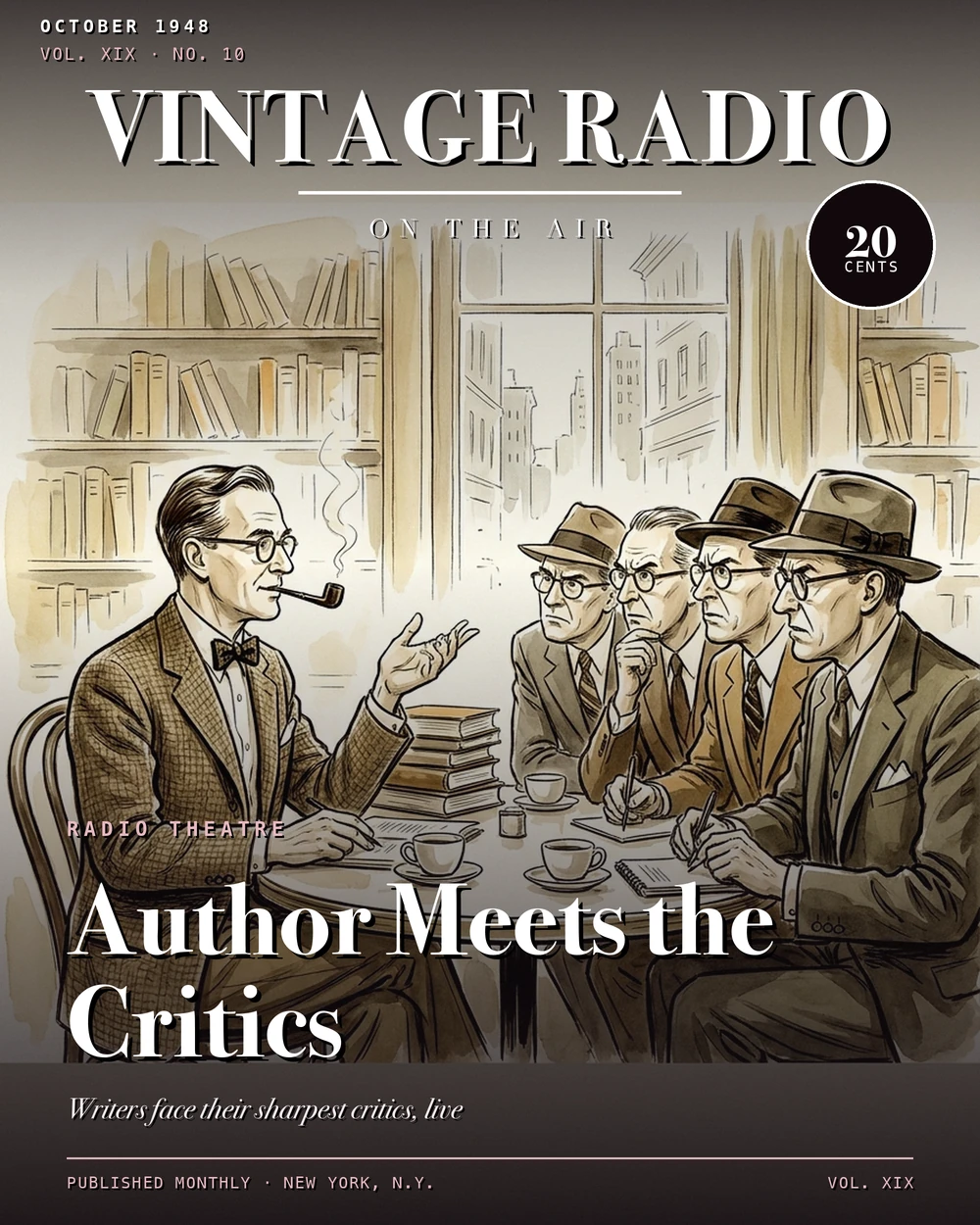
Author Meets the Critics
How a Rejected Idea Became a Radio Institution
The premise sounds simple enough: put an author in a room with two critics, let them argue about the book for thirty minutes, and see what happens. But when producer Martin Stone and his collaborator Richard Lewis — described at the time as an Albany newspaper man — first pitched the concept around 1940, radio executives turned them down flat. Too highbrow, they said. Nobody would listen. Stone ignored the verdict and put the show on the air anyway, starting in December 1940 on a local Albany, New York station before moving to Schenectady and eventually into New York City.
By 1942, Author Meets the Critics was airing on WHN, a New York City AM station, and Stone was producing it under unusual circumstances. Much of the program's early run he managed remotely, serving first as general counsel for the Lend-Lease Administration and then in the United States Navy during World War II. Broadcasting ran alongside wartime legal work — the same man who helped draft the Lend-Lease Act and the G.I. Bill was booking authors and critics for a radio book program on the side. After six years building an audience on local stations, the national Mutual network picked the show up, premiering on June 12, 1946.
The Format That Made It Work
What set the show apart was its structure, and the fact that nobody had a script. Two critics of "unquestionable stature" were brought in each week to dissect a current book for the first fifteen minutes. Then the format flipped: the author got the second half of the program to turn around and criticize the critics. No rehearsals, no pre-approved talking points, no safety net. Columnist Jack Gaver described it in his 1946 "Up and Down Broadway" column as a program where "the author of a current best-seller is tossed in with a couple of guest critics and a commentator and, if he survives 30 minutes of unscripted pro and con, may decide never to write another book."
That wasn't much of an exaggeration. The conversations got heated. Talk moved freely across questions of character, style, and the author's integrity. One author compared the discussions to "bear baiting." In one episode, Gontran de Poncins simply walked out mid-debate over his book Kabloona. Critics of genuine standing showed up — Basil Davenport, editor of the Book-of-the-Month Club, appeared in that role, as did Edith Walton of the New York Times. The guests on the author side included Charles Jackson, William L. Shirer, Eleanor Roosevelt, Al Capp, Arthur Miller, and John Dos Passos. James Jones's From Here to Eternity was among the books that went under the microscope.
The Sponsor Complications and the Lawsuit
The Mutual run came with the Book-of-the-Month Club as sponsor, which made a certain logical sense given the subject matter. But the arrangement didn't hold. In the summer of 1946, Stone departed Mutual's timeslot "under agreement," a phrase that covered what turned out to be a more contentious split. He simultaneously ran the show on WQXR — then owned by The New York Times — on Thursdays, again with Book-of-the-Month Club sponsorship, while the Mutual version continued without a sponsor.
Mutual's response was to launch a competing program called Books on Trial, sponsored by the Literary Guild, which used a "prosecuting attorney and jury" format. Stone sued, arguing Mutual had appropriated his format and was trying to confuse listeners. The case went to State Supreme Court, where Justice Bernard Botein found no conflict of ideas and ruled against Stone. The lawsuit didn't stop the show's momentum. NBC picked it up beginning May 25, 1947, and by then Stone could point to a remarkable track record — reportedly, "almost 1,000 of the world's top-flight authors and other literary figures" had appeared on the program across its local and network years.
The Moderators and What They Brought
Barry Gray handled moderating duties during the Mutual run. When the show moved to NBC, and later to ABC, John K. M. McCaffrey took over. McCaffrey was the editor of the American Mercury, which gave him genuine credentials in the literary world, though some observers felt he wasn't always fully impartial and occasionally weighed in for one side or the other — a perception that probably added to the show's unpredictable atmosphere rather than undermining it.
The ABC radio run lasted from November 24, 1949 to April 22, 1951. During that stretch, the show won the George Foster Peabody Radio Award for education in 1949. The citation was pointed in its praise — calling Author Meets the Critics "the most provocative, literate and exciting program concerning books on the air," and specifically crediting Stone for having "courageously persevered with the program although, more often than not, it lacked a sponsor and actually represented a financial loss to him." That last detail explains a lot about why the show sounded the way it did. Nobody was softening the arguments to keep a nervous advertiser happy.
The Television Life
The show crossed into television as a mid-season replacement on NBC on April 4, 1948, with General Foods Corporation as sponsor. That sponsorship ended in July 1949. The television version then migrated through several networks: ABC picked it up in 1949, NBC took it back in 1951, and the DuMont Television Network carried it from January 10, 1952 to October 10, 1954, airing Thursdays at 10 p.m. EST.
During the 1952 DuMont period, Faye Emerson briefly served as moderator, and the show was moved to prime time. Virgilia Peterson then took over for the remainder of the DuMont run. Time magazine described her on-air manner as a "coolly poised performance." Peterson, born in 1904, was an author and lecturer in her own right, and later wrote a frank autobiography titled A Matter of Life and Death. The DuMont episodes were produced by Phyllis Adams Jenkins, who would go on to produce What's the Problem?, the NBC daytime program Home starring Arlene Francis, and Dinah Shore's daytime show in the 1960s — work that earned her a reputation as a pioneer in providing serious programming for daytime television audiences.
Television guests on the program included critic Gilbert Highet appearing in the author's chair for The Classical Tradition, Norman Thomas, Fred Allen in a stint as guest host, Quentin Reynolds, Louis Budenz, and Joe Laurie Jr., author of Show Biz. Comedian Ernie Kovacs offered a backhanded compliment to the whole enterprise by parodying it on his own show as "Author Heats the Critics," in which the author attacked the critics rather than the other way around.
Martin Stone After the Show
Stone's career didn't stop with Author Meets the Critics. In 1947, he became the original producer of The Howdy Doody Show on NBC television, and his production company, Stone Associates, later produced a Canadian version of Howdy Doody for the CBC. In 1948, he organized a merchandising and licensing company called Martin Stone Associates, one of the early examples of systematic television merchandise licensing as a business model. In the 1950s, he founded radio station WVIP in Mount Kisco, New York, and in the 1960s established the Herald Tribune Radio Network, a group of suburban New York radio stations.
Stone was born May 26, 1915 in Brooklyn, graduated from Bard College in 1935, and earned his law degree from Yale in 1938. He died June 7, 1998 in Washington, D.C. The show he fought to put on the air over the objections of executives who called it too highbrow ran for more than a decade across multiple networks, won a Peabody Award, jumped to television, spawned a lawsuit, and left behind at least 53 surviving radio recordings running roughly 26 hours of audio — among them a May 1, 1947 WQXR episode featuring Norman Corwin discussing his collection of wartime radio scripts Untitled, with John Gassner and Eugene O'Neill Jr. in the critics' chairs; a March 16, 1947 WQXR broadcast examining municipal government corruption in Our Fair City; and an NBC episode from December 12, 1948 with Bruce Catton discussing The Warlords of Washington. Not bad for an idea once called too highbrow to survive.